Dr. Mary C. Neal did not set out to become a spokesperson for the afterlife. She was an accomplished orthopedic spine surgeon, a mother of four, and—by her own admission—an “everybody.” Church on Sundays, integrity and hard work during the week, and a practical trust in science to solve what could be solved. Then a kayaking accident in Chile changed everything. What followed was not a vague mist of wishful thinking, but a precise, transformative encounter with the love of God that reordered her view of life, death, and what truly matters.
In this article I’ll walk you through Mary’s story drawn from two of her talks, highlighting the moments that most powerfully communicate the reality of heaven, the meaning of a life review, the interplay of science and faith, and the daily choice each of us faces to move toward God’s love.
From Cultural Christianity to the “Religion of the Intellect”
Mary describes her upbringing as typical Midwestern: Sunday school, youth group, confirmation—the rhythms of church life without an interior life anchored in God. In college, medical school, and surgical training, she adopted what she calls “the religion of the intellect.” Smart, self-reliant, and successful, she inhabited a common false narrative: you must choose between science and faith. Without having lost a close family member and without lingering questions about death, she kept God in her “back pocket.” Prayer, when it occurred, was often a request for preferred outcomes rather than a surrender to God’s will.
That framing matters, because it shows how dramatic and credible her transformation is. She was not predisposed to mystical experiences or theological conclusions. She was living the story many of us live—until reality intruded in a Chilean river.
The Kayaking Accident in Chile: Choosing God’s Will Underwater
On what was to be the last day of a kayaking trip in southern Chile, Mary and her party approached a section of river known for 15- to 20-foot waterfalls—challenging but within their skill set. A fellow kayaker became wedged sideways in the entrance to a smaller chute, forcing Mary toward the main drop. As she crested the waterfall, she saw violent hydraulics and no clean exit. The bow of her boat pinned beneath the surface; she and the kayak were pulled eight to ten feet underwater and held there.
Training took over. Calmly and methodically she tried every maneuver to free herself or the boat. It became clear this would not work. Here is the hinge of her story: faced with death, she did not passively “let go.” She made an active choice. For the first time in her life she prayed and meant it: “God, let Your will be done.” Not as a formula for getting the outcome she wanted, but as a full surrender—whatever that meant.
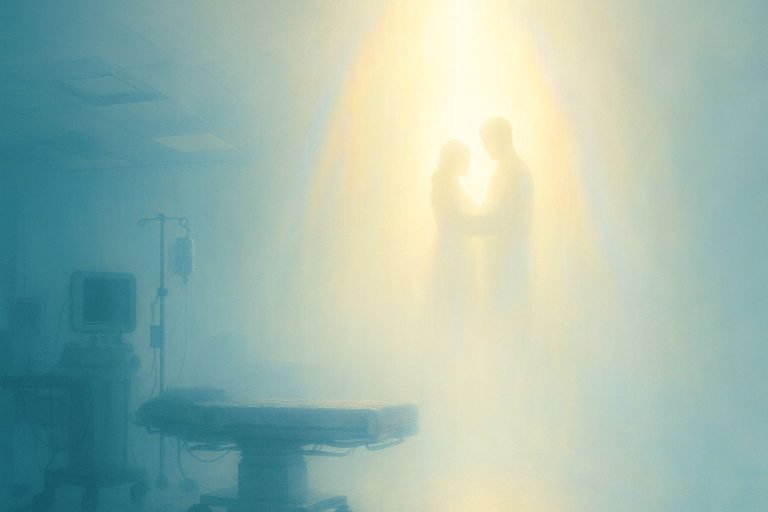
Instantly, she felt herself physically and emotionally held, comforted, and reassured. She knew—deeply knew—that her husband and children would be okay whether she lived or died. And she recognized the presence of Jesus, not as an abstraction, but as the One holding her with a love she had done nothing to earn and could never lose.
More Alive Than Alive: The Life Review That Leads to Grace
What followed was a shift in time and awareness. Mary describes it as being “alive, and then more alive”—conscious, and then more conscious. She experienced a life review, but not one of accusation. The scenes that surfaced were not her proudest moments; they were the painful ones—times she hurt others or was hurt herself. Yet the point was not condemnation, it was understanding. She re-experienced events from her perspective and from the perspectives of others. When you see a person’s story with God’s clarity, forgiveness ceases to be a self-congratulatory choice; it becomes grace. Anger, shame, and resentment dissolve into compassion.
This is deeply biblical. The apostle Paul writes, “Be kind and compassionate to one another, forgiving each other, just as in Christ God forgave you” (Ephesians 4:32). The life review Mary describes is God’s pedagogy in compassion: not ignoring evil or pain, but transforming our relationship to it through understanding and love. She also saw the long-range ripple effects of choices—how a single act could echo through dozens of lives and decades. That, too, aligns with Scripture’s insistence that our decisions matter before God (Galatians 6:7–10).
What Mary Saw: A World Woven with Love
Mary was escorted—“greeted” is her word—by radiant beings robed in pearlescent garments that seemed woven with love. Language strains here, and she says so openly: earth’s vocabulary doesn’t map heaven’s reality. But the essence is clear: love is the fabric of that realm. She walked a path suffused with beauty—especially color and flowers, which uniquely spoke to her heart—toward a threshold of a great structure. There she was given a panoramic understanding of how creation coheres: people, animals, plants, the whole living world held together in God. Not in a vague “oneness,” but in the intimate, relational order of a Father’s house.
Again the Bible gives language for this: “To be away from the body is to be at home with the Lord” (2 Corinthians 5:8). Home is the operative word. Revelation promises that God will dwell with his people, wipe away every tear, and banish death and pain (Revelation 21:3–4). Mary testifies to the atmosphere of that home: the absolute love of God as the beating heart of reality. “God is love,” John writes—not merely loving, but love itself (1 John 4:8). That is precisely what she encountered.
Sent Back With a “Laundry List”: Purpose, Pain, and Promise
At the threshold, Mary was told it was not her time and that she would return with assignments—some painful, all beyond her comfort zone. Among them was the foreknowledge of a devastating family loss, a word that would eventually unfold in her son’s unexpected death years later. She did not receive these revelations as a fatalistic script, but as a call to walk with God through real suffering for the sake of a larger good she could not yet see.
This, too, is biblical. Psalm 139:16 declares that God knows our days before we live them. That knowledge does not erase our agency; it anchors our trust. Mary’s testimony does not gloss over grief. Instead, it grounds hope in a love stronger than death (Romans 8:38–39).
Rescue and Recovery: Miracles and the Limits of Physiology
Meanwhile, on the riverbank, her companions eventually recovered Mary’s body. She had been underwater for an extended period—she recalls about thirty minutes—and exhibited signs of death, including fixed, dilated pupils. CPR began. A young rescuer pleaded, “Mary, please come back,” looking—uncannily—right where her spirit was watching. What unfolded next included a series of improbabilities: the right people in the right place, help appearing where none should have existed, and a resuscitation that her rescuers themselves attribute to God’s intervention.
Back in her medical mind, Mary examined alternate explanations with the rigor of a surgeon. Was it a dream, a hypoxic hallucination, a neurochemical surge of dopamine or serotonin, or the now-popular DMT hypothesis? She concluded that these options did not account for the clarity, coherence, moral transformation, and enduring aftereffects of her experience—nor for the corroborating details occurring around her body. Whatever else you make of her analysis, it’s not casual. She subjected her NDE to the kind of scrutiny skeptics demand and found the materialist explanations wanting.
Aftereffects You Can See: A Surgeon Who Now Leads with Love
If NDEs are real, they should leave fingerprints on a person’s life. Mary’s aftereffects are the strongest evidence of all. Her view of death changed from dread to homecoming. She still practices medicine with excellence, but her primary concern is now her patients’ spiritual flourishing. She chooses compassion in daily irritations, reframing her automatic reactions and asking, “How can I love well here?”
She also emphasizes the discipline of remembrance—what Scripture calls “setting up an Ebenezer” (1 Samuel 7:12). Because we are forgetful creatures, we must record God’s faithfulness. Mary encourages writing down the interventions and mercies you’ve seen so you don’t let a lifetime of divine fingerprints be smudged by tomorrow’s minor frustrations.
Science and Faith Together: Intellectual Honesty and a Bigger Story
Mary entered her NDE as a scientist and returned as one. She does not deny the brain’s role in perception or the value of careful inquiry; she insists on it. What changed is the size of her story. Science describes mechanisms within the physical world; it does not exhaust the meaning of reality. She invites honest skeptics to examine the cumulative evidence—multiple lines of testimony, corroborated details, and the moral fruit of transformed lives—and to do so with intellectual humility rather than what she calls “intellectual arrogance.”
For readers who are wrestling, this may be your next faithful step: not an abandonment of reason, but an expansion of it. Consider her claim on its merits. Follow the evidence to the boundary of your current explanations and ask whether love, purpose, and the persistence of consciousness point beyond mere chemistry.
The Core Lesson: Everything Matters Because God Is Love
Mary returns to one refrain: everything matters. Words, actions, human interactions, how we steward the earth—none of it is trivial. That’s because life continues and love is ultimate. “If there were no life after death,” she says, “nothing would matter.” But there is. The life review taught her this at the level of lived reality: what we do echoes in lives we do not see. Grace is not a loophole; it is a power that turns wounds into wisdom and enemies into neighbors.
This is not theoretical spirituality. It is a daily choice. We can walk toward God or away from Him in every conversation, decision, and habit. Jesus shows us what this looks like and offers Himself as both the path and the power. If you’ve considered yourself a person of faith but found your trust crumbling under loss, Mary’s story offers a reset: God’s love is not an outcome machine; it is the home that holds you through outcomes you do not choose.
Living in Joy Now: Present-Tense Hope
One of the most compelling aftereffects Mary describes is joy. Not a circumstantial happiness that rises and falls with ease and pain, but a settled, present-tense joy rooted in who God is and where home really is. She learned to release the past, refuse anxiety about the future, and attend to the grace at hand today. That posture doesn’t minimize sorrow; it sanctifies it. It allows you to face heartbreak without losing your center.
For many of you who read NDE Questions, this is the question beneath the questions: How do I live now, in this body and this world, in the light of eternity? Mary’s answer is practical. Choose God’s will when control is impossible. Practice compassion when irritation feels natural. Remember and recount God’s faithfulness. Pursue excellence in your calling, but prioritize the soul—yours and others’. And fix your hope on the God who is love.
Why Mary Neal’s NDE Matters for You
You do not need a waterfall to reorient your life. You need truth and a willingness to act on it. Mary’s testimony confirms what Scripture has announced all along: we were made for communion with God; death is a door, not a dead end; and love is the law of the house to which we are going. If you are grieving, let her story reassure you that those who die in Christ are “at home with the Lord” (2 Corinthians 5:8). If you are angry or ashamed, let her life review instruct you: understanding births grace, and grace heals what time cannot. If you are skeptical, engage the evidence with an honest mind. And if you are simply weary, take the next small step toward God’s love today.
“God will dwell with them… He will wipe away every tear from their eyes… death shall be no more” (Revelation 21:3–4).
“God is love” (1 John 4:8).
“All the days ordained for me were written in your book before one of them came to be” (Psalm 139:16).
“Be kind and compassionate… forgiving each other, just as in Christ God forgave you” (Ephesians 4:32).
“We are of good courage… and would rather be away from the body and at home with the Lord” (2 Corinthians 5:8).
These are not slogans for crisis; they are coordinates for a life that makes sense.
Want to Go Deeper?
If Mary’s story stirred your heart or sharpened your questions, I encourage you to read her full account. It will give you context for the river, the rescue, the life review, the beauty she saw, and the “assignments” she brought back—along with the grace that has sustained her since. Buy Mary C. Neal’s book, To Heaven and Back.
May her journey help you take your next step toward the God who loves you, now and forever.